A chief died before his cocoa-pod palanquin was ready, so they buried him in it. How Teshie invented the fantasy coffin
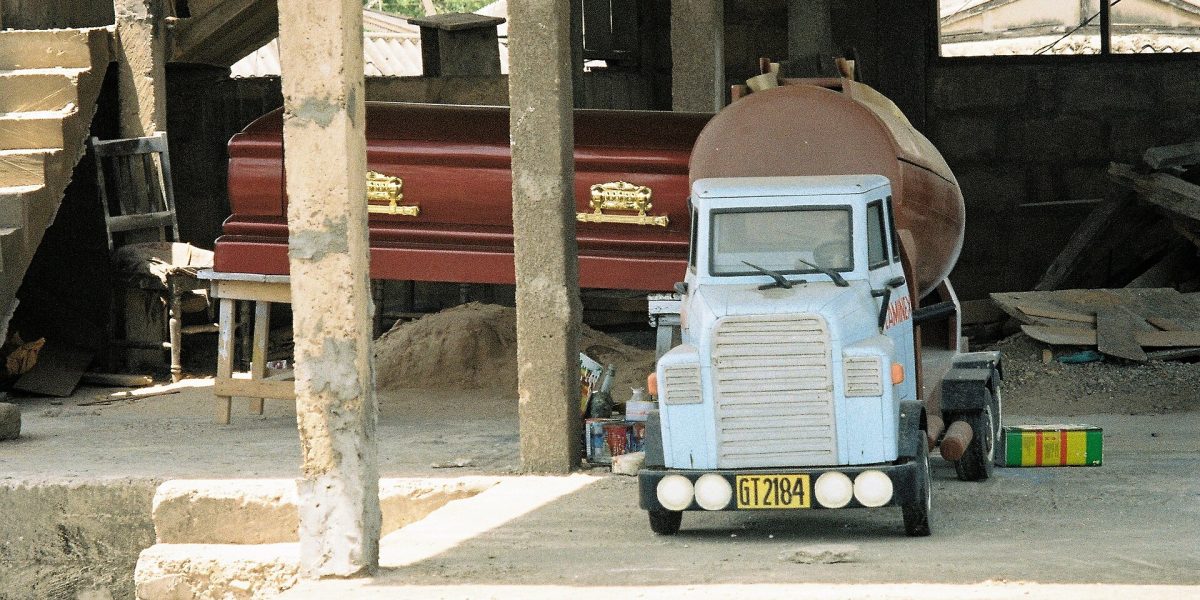
In the 1950s, a Teshie carpenter named Seth Kane Kwei built a palanquin in the shape of a cocoa pod for a chief to ride at a festival. The chief died before the festival came, and his family buried him in it.
That is the story most often told about the birth of Ghana’s fantasy coffins, the carved and painted caskets shaped like fish, aeroplanes, bottles, cars, cameras and sandals that have made a small Ga fishing town famous in art museums around the world.
The carpenter and his grandmother
Kane Kwei was born in 1922 and belonged to a royal Ga clan in Teshie, east of central Accra. As a young man he trained with a carpenter, making ordinary rectangular coffins and the palanquins that carry chiefs in procession. After the cocoa-pod burial, he made a coffin shaped like an aeroplane for his grandmother, who had watched planes fly over Teshie for years without ever boarding one.
Word spread. Families began ordering coffins that told the story of the person inside: a fishing boat or a fish for a fisherman, a hen for a mother who had raised many children, a Mercedes for a businessman, a Bible for a pastor, a hammer for a builder. Kane Kwei ran his workshop until his death in 1992.
What the Ga call them
In Ga, these are known as abebuu adekai, proverb boxes. The name matters. The shapes are not jokes. They sit inside a funeral culture in which the dead are believed to continue their lives in another world, and in which the burial is one of the most important and expensive events in a family’s life. A coffin that shows what someone did, or what they stood for, carries them into that next life with their identity intact.
Some shapes carry status rather than trade. Certain animals, such as the leopard or the eagle, have historically been linked to chiefs and lineage heads, and families are expected to use them only if the deceased held the right position.
From Teshie to the museum
International attention began in the 1970s, when foreign collectors and curators came across the coffins. A major Paris exhibition in 1989, “Magiciens de la Terre” at the Centre Pompidou, put Teshie coffins in front of the European art world. Pieces from Kane Kwei’s workshop are now in the collections of museums including the Fine Arts Museums of San Francisco, which holds a cocoa-pod coffin.
That creates an odd double life. The same workshop that builds coffins to be buried in Ga cemeteries sells almost identical pieces to galleries and collectors abroad, where they are never used for burial.
The workshop today
The Kane Kwei Carpentry Workshop is still in Teshie, run by his descendants and managed by his grandson, Eric Adjetey Anang, who has exhibited internationally and taught carving abroad. Around a dozen workshops in the Accra area now make fantasy coffins, and apprentices learn the trade from the masters in the same way Kane Kwei did.
Visitors to Teshie can walk into the workshops and watch a coffin being carved. The most requested design, several carpenters say, is still the one that started it all: something shaped like the job the person did every day.