NGOs, Not Saviors: Why Ghana’s Local Governments Need Strengthening
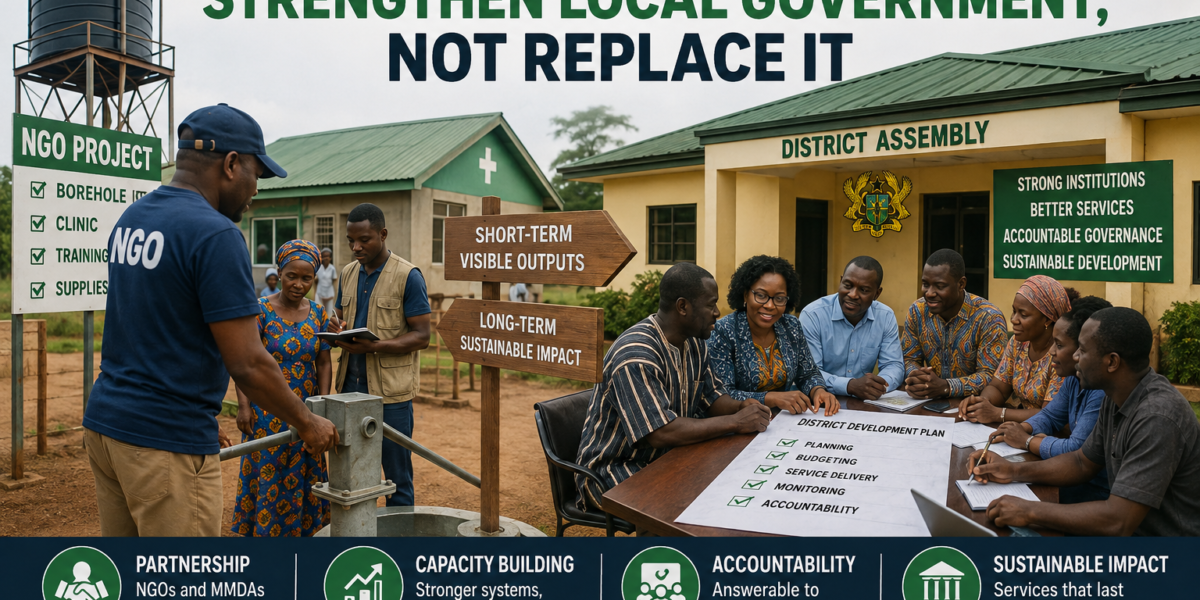
In Ghana, an NGO can drill a borehole, build a clinic, or train community health volunteers in a matter of months. However, when the funding ends, who pays the mechanic, replaces the supplies, updates the records, or answers residents when the service fails?
The Role of NGOs in Strengthening Local Governments
In Ghana, the role of NGOs is not to replace that of the Metropolitan, Municipal, and District Assemblies (MMDAs), but to strengthen the public institutions that will remain after donor funding and project staff have departed. This approach is crucial in Ghana, where the Medium-Term National Development Policy Framework for 2026–2029 identifies accountable governance as a national priority.
According to a recent report, many development projects in Ghana are judged successful by what is delivered at launch rather than by what local institutions can sustain five years later. This institutional-strengthening approach is essential in ensuring that citizens are not forced to depend on a permanent, unelected organisation for public services that elected local government is responsible for providing.
The Need for Institutional Strengthening
Evidence shows that government institutions and development partners can expand service delivery effectively when they work through shared public structures. For instance, UNICEF reported helping Ghana scale up integrated social services from 170 to 180 districts in 2024, alongside training for more than 100 district personnel and 150 probation officers. However, wider program coverage may not produce lasting improvements unless NGO interventions are incorporated into the assemblies’ existing planning, reporting, budgeting, and maintenance systems.
The Auditor-General’s report on the 2024 accounts of district assemblies identified recurring financial and administrative irregularities, attributed partly to key officials’ limited commitment to enforcing relevant legislation and administrative instructions, and to the absence of sanctions against those found culpable. A recent Ghanaian study of decentralisation and local government performance similarly found that although citizens were satisfied with some services, central government control and influence continued to weaken the effectiveness of decentralisation.
The Problem of Institutional Substitution
The problem arises when NGO projects appear effective in the short term but operate through parallel arrangements that weaken rather than strengthen existing public institutions. This form of institutional substitution takes shape when an NGO produces a separate database that district planners cannot access, provides equipment without a maintenance budget, recruits community volunteers without a clear supervision plan, or creates a facility without assigning responsibility for its ongoing management.
Research on NGO intervention and decentralisation in northern Ghana warns that strengthening civil society organisations without sufficiently connecting them to local government structures can weaken decentralisation. Although communities may initially receive useful services, such arrangements can leave the public institution expected to sustain the service without the necessary information, resources, or administrative capacity.
A Call for Collaboration
This is not a call for political interference in NGOs, nor an indictment of public officials alone. The goal is disciplined collaboration between the two. Research on Ghana’s HIV/AIDS response found that the Ghana AIDS Commission’s partnerships with civil society organisations worked best when paired with clear governance principles, including strategic planning and competitive tendering, and dedicated funding mechanisms tailored to how CSOs were engaged.
Ghana’s pandemic response also showed that a public agency and civil society, understanding their roles in the pandemic and how dependent each is on the other, could mobilise promptly. To move Ghana in this direction, four practical changes are recommended.
Implementing Institutional Strengthening
First, each major NGO intervention should have a district partnership compact linked to the assembly’s medium-term development plan. The compact should specify who is responsible for finance, procurement, staffing, data, and maintenance, and when the project will close. Where traditional authorities or community representatives play a material role in delivery, they should be party to the compact.
Secondly, each assembly’s website should host a public digital register of NGO projects and donors. The register should record the project location, target population, budget, implementing partners, completion date, and responsible office. This would help planners identify duplication and unserved communities and would let citizens know whom to ask if promises go unfulfilled.
Third, donors must invest in capacity transfer as a concrete, verifiable outcome rather than a short workshop held before an NGO’s departure. Named district staff should be trained to perform duties such as keeping financial records, managing procurement, tracking data, engaging the community, and maintaining equipment, so that the service continues after the NGO leaves. This transfer of capacity should be documented, whether through a contract clause or an independent evaluation.
It is not enough to count how many people benefited; the focus should be on what the responsible institution can do better. By implementing these changes, Ghana can strengthen its local governments and ensure that public services are delivered effectively and sustainably.
Source: Joy Online