Samia Nkrumah disputes claims Ghanaians welcomed her father’s overthrow
The severed head of Kwame Nkrumah's statue lay in the dust of Accra in February 1966, the month a military coup ended his presidency. Fifty-nine years later, his daughter stood in Nkroful and told a crowd that the celebrations that followed that destruction did not speak for Ghana.
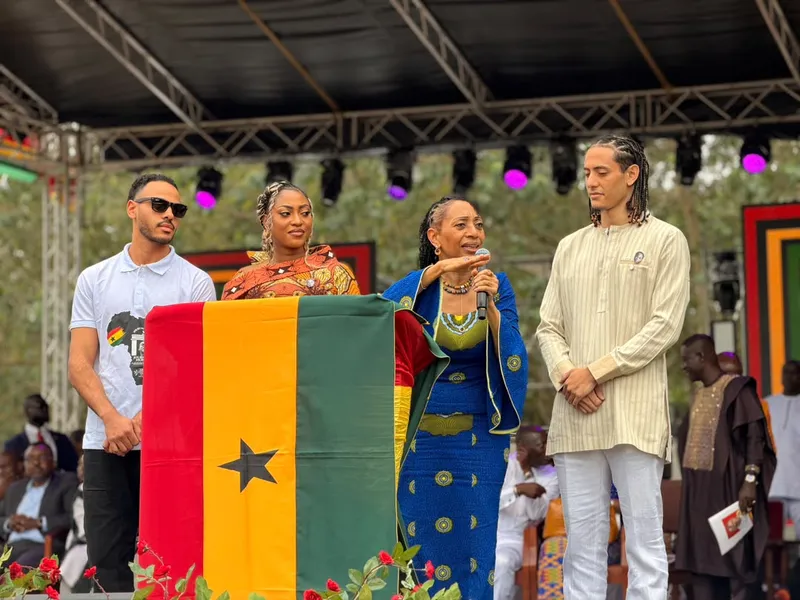
Samia Yaba Nkrumah, speaking at the 2026 NkrumahFest in the Ellembelle District of the Western Region, rejected the narrative that Ghanaians universally welcomed the overthrow of her father, Ghana's first president, Osagyefo Dr Kwame Nkrumah. The statue that once stood at what is now the Kwame Nkrumah Memorial Park and Museum in Accra had its head severed after the coup. Samia said the destruction of the monument and the festivities that accompanied it should not be interpreted as representing the feelings of all Ghanaians.
"That negative propaganda that Osagyefo when he left, Ghanaians were happy is not true," she said.
Nkrumah was overthrown on February 24, 1966, while on a state visit to North Vietnam. The coup, led by army officers under the National Liberation Council, came after years of economic strain and growing authoritarianism in his government. Crowds in Accra were filmed pulling down his statue, an image that has been replayed in documentaries and history books ever since. Samia's remarks at Nkroful, the village where her father was born in 1909, were aimed directly at that footage.
She thanked individuals and organisations working to document what she considers a more accurate account of Nkrumah's life and political legacy. She pointed to the unveiling of a new statue of Nkrumah at a roundabout in Sunyani, the capital of the Bono Region, as evidence of renewed interest in his ideas. For Samia, the contrast between the new monument and the destroyed one carried weight.
"When we unveiled the statue at the roundabout, I realised that yes, we are going to rise. Nzimaland will rise, Africa will rise, Ghana will rise, and Africans everywhere are going to rise," she said.
She stressed that the value of such monuments lies not in the bronze or stone themselves but in the ideas they are meant to represent. According to her, the symbols should remind Ghanaians of a political philosophy built around confidence, strength and freedom.
Samia also pushed back against characterisations of her father as an isolationist or a rigid thinker whose ideas were disconnected from the wider world. Critics have long described Nkrumah's later years in power as insular, marked by a narrowing of political space and a reliance on a small circle of advisers. Samia disputed that framing. She argued that his commitment to Ghanaian nationalism and Pan-Africanism did not stop him from building relationships with people across different countries and continents.
"They say he was an isolationist. They say he was dogmatic, rigid in his ideas. Let me tell you, this is not true," she said.
Nkrumah's international record is documented. He corresponded with leaders across Africa, Europe and the Americas. He hosted the All-African People's Conference in Accra in 1958. He pushed for the Organisation of African Unity, founded in 1963 in Addis Ababa. His government maintained diplomatic ties with both Western and Eastern blocs during the Cold War. Samia argued that these relationships demonstrate that his Ghanaian nationalism existed alongside a broader Pan-African outlook, not in opposition to it.
The Nkrumah family's renewed involvement in NkrumahFest is partly aimed at younger generations, she said. The family wants young Ghanaians and Africans to examine Nkrumah's ideas and legacy beyond what she described as negative historical narratives. The festival, held annually at Nkroful, has in recent years drawn scholars, politicians and musicians, with programming that includes lectures on Nkrumah's writings and panels on Pan-Africanism.
Samia herself has a political history independent of her father's. She led the Convention People's Party from 2011 to 2015 and served as a member of parliament for the Jomoro constituency from 2009 to 2013. She was the first woman to chair a major political party in Ghana. Her return to the NkrumahFest stage this year placed her at the centre of a debate that has never fully settled in Ghanaian public life: how to remember the man who led the country to independence in 1957 and was removed from power nine years later.
The statue in Sunyani stands at a roundabout on one of the city's busiest roads. Drivers pass it daily. The severed head of the old Accra statue is no longer visible to the public, kept in storage by the Ghana Museums and Monuments Board. Samia's remarks in Nkroful did not call for its restoration. She spoke instead about what the new statue represents, and about the ideas she said it carries forward.
According to Joy Online.